India–New Zealand Free Trade Agreement Explained: Strategy, Structure, and Stakes
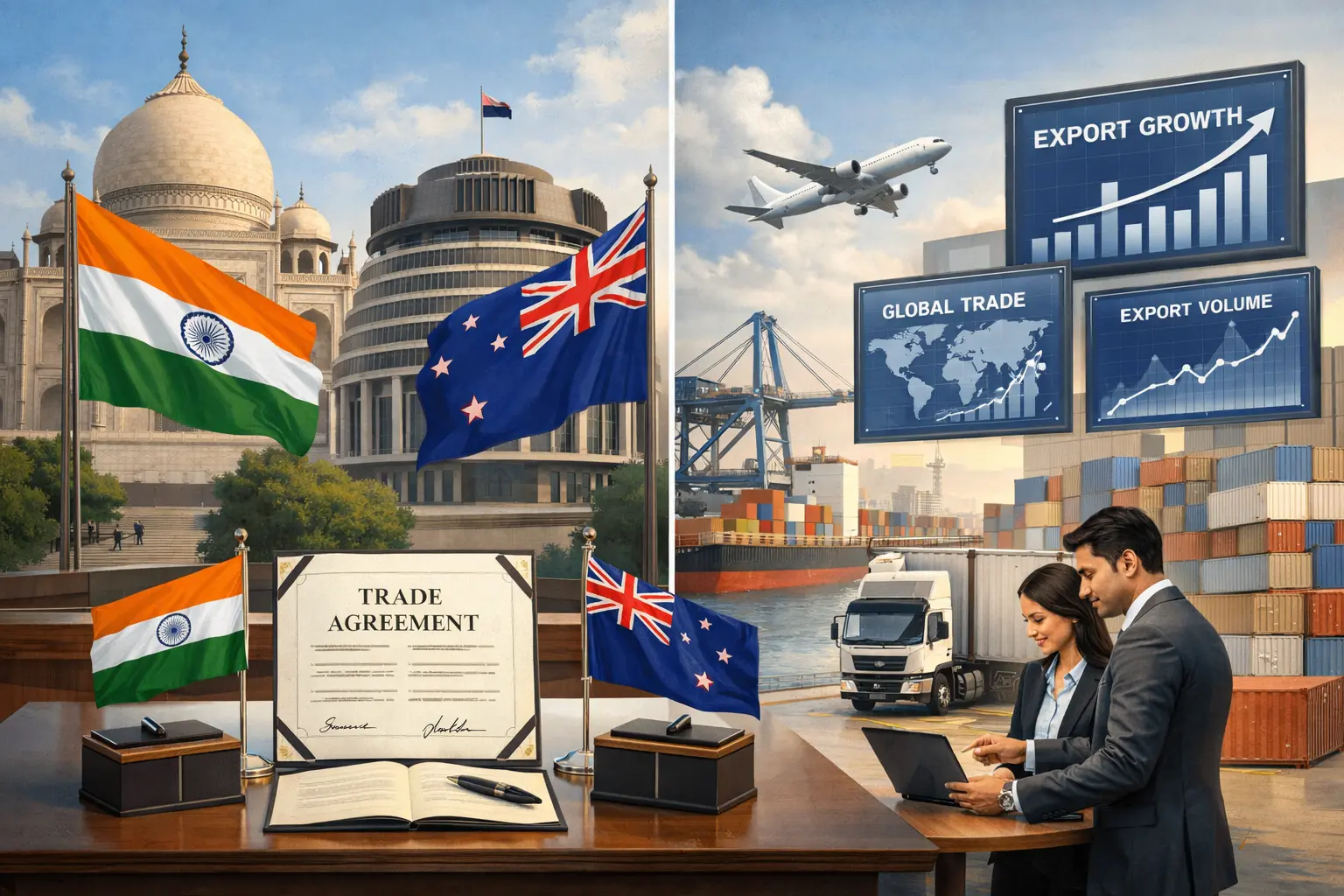
India’s trade strategy has entered a decisive phase. In a shifting global order shaped by trade wars, geopolitical uncertainty, and supply-chain realignment, India has quietly accelerated its Free Trade Agreement (FTA) agenda. The recently signed India–New Zealand FTA, India’s third such agreement in a single year, has drawn attention across global media. This is not because the deal is dramatic—but because it is carefully designed. Understanding why this agreement matters requires looking beyond headlines and into its structure, priorities, and long-term implications.
India’s FTA Push: A Broader Strategic Context
Over the past decade, India was often seen as cautious—sometimes hesitant—about signing large trade agreements. Concerns over the domestic industry, agriculture, and employment slowed negotiations. That approach has now shifted.
Global trade patterns changed significantly after tariff escalations and protectionist policies emerged in major economies. As uncertainty increased, India began diversifying its trade partnerships rather than relying heavily on a few markets.
In the last five years, India has signed seven FTAs, with momentum accelerating after 2023. The objective is clear:
- Expand export access
- Secure supply chains
- Attract long-term investment
- Protect sensitive domestic sectors
The India–New Zealand FTA fits directly into this framework.
The India–New Zealand FTA: Key Features at a Glance
The agreement between India and New Zealand focuses on trade facilitation, tariff reduction, investment cooperation, and services mobility. Its design reflects careful prioritisation rather than broad concessions.
Key highlights include:
- Zero-duty access for 100% of Indian exports to New Zealand
- Tariff concessions on approximately 95% of New Zealand exports to India
- Commitments toward investment flows worth up to USD 20 billion over 15 years
- Improved mobility for skilled Indian professionals
- Strong safeguards for India’s sensitive agricultural sectors, especially dairy
These elements explain why the agreement is often described as favourable to India’s long-term interests.
Why the Dairy Sector Decision Matters
One of the most discussed aspects of the FTA is what India did not include.
New Zealand is one of the world’s largest dairy exporters. Products such as milk powder, butter, cheese, and whey form a critical part of its export economy. For years, New Zealand sought deeper access to India’s dairy market.
India declined.
Under the FTA:
- Indian dairy markets remain protected
- No tariff-free access was granted to New Zealand dairy products
This decision safeguards millions of Indian dairy farmers, many of whom operate at small and cooperative levels. From India’s perspective, opening the dairy sector would have posed social and economic risks far beyond trade benefits.
The reaction inside New Zealand is telling. Opposition parties have criticised their own government, arguing that the agreement gives India broad access while limiting New Zealand’s most valuable exports. This criticism itself indicates how firmly India negotiated.
Export Advantages for India
While dairy was protected, India secured comprehensive market access for its exports.
Indian goods now enter New Zealand with zero tariffs across sectors such as:
- Pharmaceuticals
- Textiles and garments
- Engineering goods
- Auto components
- Chemicals
- Agricultural value-added products
India–New Zealand bilateral trade stood at approximately USD 2.4 billion last year. With tariff barriers removed, analysts expect this figure to grow to USD 5–7 billion in the medium term.
For Indian exporters, New Zealand offers:
- A stable, high-income consumer market
- Predictable regulatory systems
- A gateway to broader Pacific trade networks
Skilled Workforce and Services Mobility
Another under-reported but important aspect of the agreement is services and workforce mobility.
The FTA facilitates greater access for Indian skilled professionals, including:
- IT and technology specialists
- Engineers
- Healthcare professionals
- Education and research professionals
This provision has also attracted political debate within New Zealand, where opposition groups argue that the agreement favours Indian labour mobility more than domestic interests.
From India’s standpoint, this aligns with its strength as a global supplier of skilled human capital.
Investment Commitments and Long-Term Outlook
The agreement includes provisions encouraging long-term investment cooperation, with potential commitments estimated at USD 20 billion over 15 years.
These investments may flow into:
- Infrastructure
- Renewable energy
- Education and skill development
- Technology partnerships
- Agri-processing and logistics
Rather than short-term trade volume spikes, the structure emphasises sustained economic integration.
India’s FTA Network: Countries and Years
To understand where the New Zealand agreement fits, it helps to look at India’s broader FTA landscape:
- Sri Lanka – 2000
- Thailand (Early Harvest Scheme) – 2004
- Singapore (CECA) – 2005
- South Korea (CEPA) – 2010
- Japan (CEPA) – 2011
- ASEAN – 2010 (goods), later expanded
- United Arab Emirates (CEPA) – 2022
- Australia (ECTA) – 2022
- United Kingdom – 2025
- Oman – 2025
- New Zealand – 2025
India is also negotiating or exploring agreements with:
- The European Union
- The Eurasian Economic Union
- Canada and other strategic partners
This shows a clear pattern: India is prioritising FTAs that combine market access with domestic protection.
Pressure on Other Major Economies
As India continues signing FTAs, indirect pressure builds on countries that do not yet have trade agreements with India—most notably the United States.
When competitors gain tariff-free access to India’s market, companies in non-FTA countries face a disadvantage. Over time, this may push larger economies to reconsider their negotiating positions with India.
Importantly, India has signalled that:
- Sensitive sectors like dairy will remain protected
- FTAs must align with domestic economic priorities
This approach ensures that trade liberalisation does not come at the cost of internal stability.
What This Signals About India’s Trade Philosophy
The India–New Zealand FTA reflects a broader shift in India’s trade philosophy:
- Selective openness instead of blanket liberalisation
- Data-driven negotiation instead of ideological positioning
- Long-term resilience over short-term optics
Rather than maximising headline trade volumes, India is focusing on agreements that strengthen its role as both a production base and a consumption market.
The India–New Zealand Free Trade Agreement is not significant because it is dramatic, but because it is deliberate. By securing zero-duty export access, protecting critical domestic sectors, and expanding skilled mobility, India has reinforced its trade strategy without overexposing its economy. As India signs more such agreements, its role in global trade will increasingly be shaped by balance rather than dependence. For businesses, policymakers, and observers, the message is clear: India’s trade engagement is becoming more confident, structured, and selective.
Disclaimer: This article is based on publicly available reports and independent analysis. Readers are encouraged to consult multiple sources for a complete picture.






No comments yet. Be the first to comment!